Available courses

This course prepares students to make successful transitions to postsecondary destinations as they investigate specific postsecondary options based on their skills, interests, and personal characteristics. Students will explore the realities and opportunities of the workplace and examine factors that affect success, while refining their job-search and employability skills. Students will develop their portfolios with a focus on their targeted destination and develop an action plan for future success.

Prerequisite: None

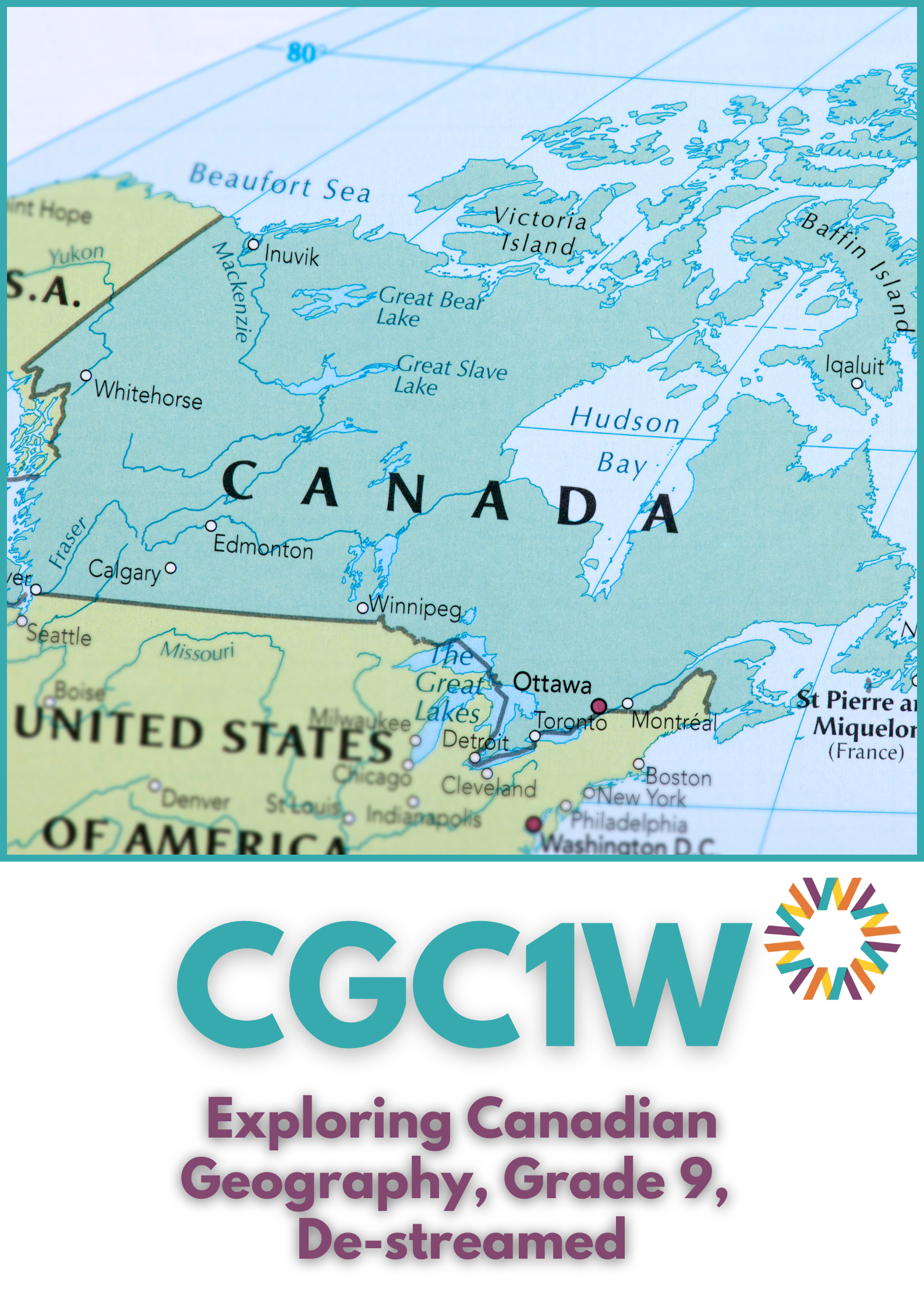
This course builds on learning in Grades 7 and 8 in geography. Students will explore relationships within and between Canada’s natural and human systems and how they interconnect with other parts of the world. Students will also examine environmental and economic issues, and their impact related to topics such as natural resources and industries, careers, land use and responsible development, and sustainability. In addition, students will understand the connections that diverse communities and individuals have with the physical environment and each other throughout Canada, including First Nations, Métis, and Inuit perspectives. Students will apply geographic thinking, use the geographic inquiry process, and use geospatial technologies throughout their investigations.

Course type: De-streamed
Prerequisite: None

This course enables students to continue to develop and consolidate the foundational knowledge and skills that they need for reading, writing, and oral and visual communication. Throughout the course, students will continue to enhance their media literacy and critical literacy skills, and to develop and apply transferable skills, including digital literacy. Students will also make connections to their lived experiences and to society and increase their understanding of the importance of language and literacy across the curriculum.

Prerequisite: None

This course enables students to develop their understanding of concepts related to biology, chemistry, physics, and Earth and space science, and to relate science to technology, society, and the environment. Throughout the course, students will develop and refine their STEM skills as they use scientific research, scientific experimentation, and engineering design processes to investigate concepts and apply their knowledge in situations that are relevant to their lives and communities. Students will continue to develop transferable skills as they become scientifically literate global citizens.

Prerequisite: None

This course enables students to consolidate, and continue to develop, an understanding of mathematical concepts related to number sense and operations, algebra, measurement, geometry, data, probability, and financial literacy. Students will use mathematical processes, mathematical modelling, and coding to make sense of the mathematics they are learning and to apply their understanding to culturally responsive and relevant real-world situations. Students will continue to enhance their mathematical reasoning skills, including proportional reasoning, spatial reasoning, and algebraic reasoning, as they solve problems and communicate their thinking.

Prerequisite: None

This course explores social, economic, and political developments and events and their impact on the lives of different individuals, groups, and communities, including First Nations, Métis, and Inuit individuals and communities, in Canada since 1914. Students will examine the role of conflict and cooperation in Canadian society, Canada’s evolving role within the global community, and the impact of various individuals, organizations, and events on identities, citizenship, and heritage in Canada. Students will develop an understanding of some of the political developments and government policies that have had a lasting impact on First Nations, Métis, and Inuit individuals and communities. They will develop their ability to apply the concepts of historical thinking and the historical inquiry process, including the interpretation and analysis of evidence, when investigating key issues and events in Canadian history since 1914.

Prerequisite: None

This course explores, within the context of families, some of the fundamental challenges people face: how to meet basic needs, how to relate to others, how to manage resources, and how to become responsible members of society. Students will explore adolescent development and will have opportunities to develop interpersonal, decision-making, and practical skills related to daily life. They will learn about the diverse ways in which families function in Canada and will use research skills as they explore topics related to individual and family needs and resources.

Prerequisite: None

This course helps students develop cutting-edge digital technology and computer programming skills that will support them in contributing to and leading the global economic, scientific and societal innovations of tomorrow. Students will learn and apply coding concepts and skills to build hands-on projects and investigate artificial intelligence, cybersecurity, and other emerging digital technologies that connect to a wide range of fields and careers. Using critical thinking skills with a focus on digital citizenship, students will investigate the appropriate use and development of the digital technologies that they encounter every day, as well as the benefits and limitations of these technologies.

Course type: Open
Prerequisite: None

This course introduces students to the world of business and what is required to be successful, ethical, and responsible in today’s economy. Students will develop the knowledge and skills needed to be an entrepreneur who knows how to respond to local and global market opportunities. Throughout the course, students will explore and understand the responsibility of managing different functions of a business. This includes accounting, marketing, information and communication technology, financial management, human resources, and production.

Discipline: Introduction to Business Studies and Entrepreneurship
Course type: Open
Prerequisite: None

This course explores rights and responsibilities associated with being an active citizen in a democratic society. Students will explore issues of civic importance and the influence of social media, while developing their understanding of the role of civic engagement and of political processes in the local, national, and/or global community. Students will apply the concepts of political thinking and the political inquiry process to investigate, and express informed opinions about, a range of political issues and developments that are both of significance in today’s world and of personal interest to them. This course also includes learning on digital literacy and critical-thinking skills, the mechanisms of government, Indigenous governance systems and structures, the historical foundations of the rights and freedoms we enjoy in Canada, ways in which government policy affects individuals’ lives and the economy, and ways for students to serve their communities.

Prerequisite: None

This course is designed to extend the range of oral communication, reading, writing, and media literacy skills that students need for success in their secondary school academic programs and in their daily lives. Students will analyse literary texts from contemporary and historical periods, interpret and evaluate informational and graphic texts, and create oral, written, and media texts in a variety of forms. An important focus will be on the selective use of strategies that contribute to effective communication. This course is intended to prepare students for the compulsory Grade 11 university or college preparation course.

Prerequisite: English, Grade 9, Academic or Applied

This course enables students to broaden their understanding of relationships and extend their problem-solving and algebraic skills through investigation, the effective use of technology, and abstract reasoning. Students will explore quadratic relations and their applications; solve and apply linear systems; verify properties of geometric figures using analytic geometry; and investigate the trigonometry of right and acute triangles. Students will reason mathematically and communicate their thinking as they solve multi-step problems.

Prerequisite: Grade 9 Mathematics, Academic

This course teaches students how to develop and achieve personal goals for future learning, work, and community involvement. Students will assess their interests, skills, and characteristics and investigate current economic and workplace trends, work opportunities, and ways to search for work.The course explores postsecondary learning and career options, prepares students for managing work and life transitions, and helps students focus on their goals through the development of a career plan.

Prerequisite: None

This course enables students to enhance their understanding of concepts in biology, chemistry, earth and space science, and physics, and of the interrelationships between science, technology, society, and the environment. Students are also given opportunities to further develop their scientific investigation skills. Students will plan and conduct investigations and develop their understanding of scientific theories related to the connections between cells and systems in animals and plants; chemical reactions, with a particular focus on acid–base reactions; forces that affect climate and climate change; and the interaction of light and matter.

Prerequisite: Science, Grade 9, Academic or Applied

This course provides students with the skills and strategies they need to make the transition to college and university preparation courses in English and other secondary school disciplines. Students will be encouraged to develop independence in a range of academic tasks. They will participate in debates and lead classroom workshops; read and interpret literary works and academic texts; write essays, narratives, and reports; and apply a range of learning strategies and research skills effectively. Students will further develop their ability to respond critically to print and media texts.

This course enables students to deepen their understanding of chemistry through the study of the properties of chemicals and chemical bonds; chemical reactions and quantitative relationships in those reactions; solutions and solubility; and atmospheric chemistry and the behaviour of gases. Students will further develop their analytical skills and investigate the qualitative and quantitative properties of matter, as well as the impact of some common chemical reactions on society and the environment.

Prerequisite: Science, Grade 10, Academic

This course prepares students to use English with increasing fluency and accuracy in classroom and social situations and to participate in Canadian society as informed citizens. Students will develop the oral-presentation, reading, and writing skills required for success in all school subjects. They will extend listening and speaking skills through participation in discussions and seminars; study and interpret a variety of grade-level texts; write narratives, articles, and summaries in English; and respond critically to a variety of print and media texts.

Prerequisite: English as a Second Language ESL Level 3 (ESLCO), or Placement Test

This course develops students’ understanding of the basic concepts of physics. Students will explore kinematics, with an emphasis on linear motion; different kinds of forces; energy transformations; the properties of mechanical waves and sound; and electricity and magnetism. They will enhance their scientific investigation skills as they test laws of physics. In addition, they will analyse the interrelationships between physics and technology, and consider the impact of technological applications of physics on society and the environment.

Prerequisite: Science, Grade 10, Academic

This course introduces the mathematical concept of the function by extending students’ experiences with linear and quadratic relations. Students will investigate properties of discrete and continuous functions, including trigonometric and exponential functions; represent functions numerically, algebraically, and graphically; solve problems involving applications of functions; investigate inverse functions; and develop facility in determining equivalent algebraic expressions. Students will reason mathematically and communicate their thinking as they solve multi-step problems.

Prerequisite: Principles of Mathematics, Grade 10, Academic

This course introduces students to computer science. Students will design software independently and as part of a team, using industry-standard programming tools and applying the software development life-cycle model. They will also write and use subprograms within computer programs. Students will develop creative solutions for various types of problems as their understanding of the computing environment grows. They will also explore environmental and ergonomic issues, emerging research in computer science, and global career trends in computer-related fields.

Prerequisite: None

This course introduces students to the fundamental principles and procedures of accounting. Students will develop financial analysis and decision-making skills that will assist them in future studies and/or career opportunities in business. Students will acquire an understanding of accounting for a service and a merchandising business, computerized accounting, financial analysis, and ethics and current issues in accounting.

Prerequisite: None

This course furthers students’ understanding of the processes that occur in biological systems. Students will study theory and conduct investigations in the areas of biodiversity; evolution; genetic processes; the structure and function of animals; and the anatomy, growth, and function of plants. The course focuses on the theoretical aspects of the topics under study, and helps students refine skills related to scientific investigation.

Prerequisite: Science, Grade 10, Academic

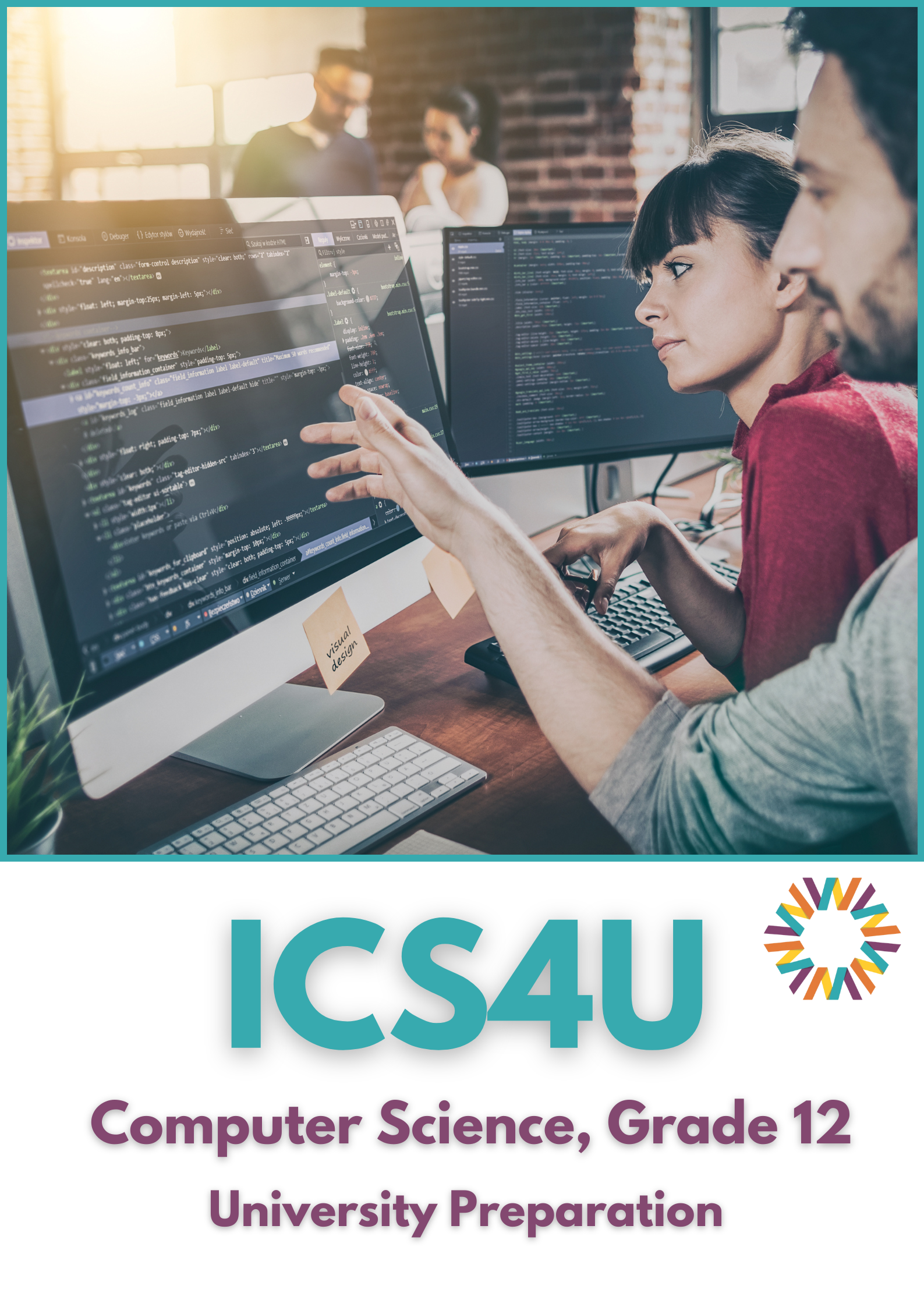
This course enables students to further develop knowledge and skills in computer science. Students will use modular design principles to create complex and fully documented programs, according to industry standards. Student teams will manage a large software development project, from planning through to project review. Students will also analyse algorithms for effectiveness. They will investigate ethical issues in computing and further explore environmental issues, emerging technologies, areas of research in computer science, and careers in the field.

Prerequisite: Introduction to Computer Science, Grade 11, University Preparation

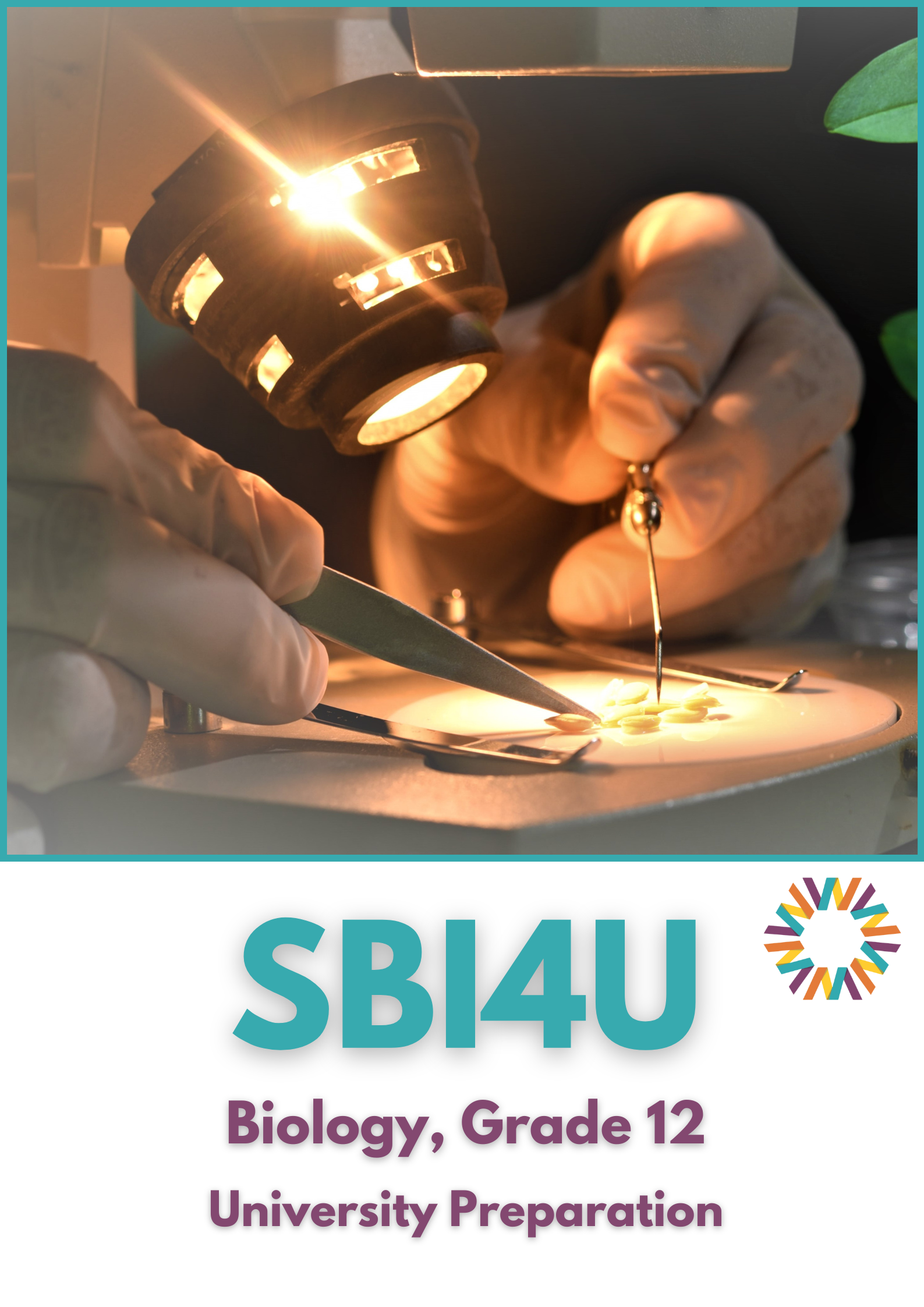
This course provides students with the opportunity for in-depth study of the concepts and processes that occur in biological systems. Students will study theory and conduct investigations in the areas of biochemistry, metabolic processes, molecular genetics, homeostasis, and population dynamics. Emphasis will be placed on the achievement of detailed knowledge and the refinement of skills needed for further study in various branches of the life sciences and related fields.

Prerequisite: Biology, Grade 11, University Preparation